
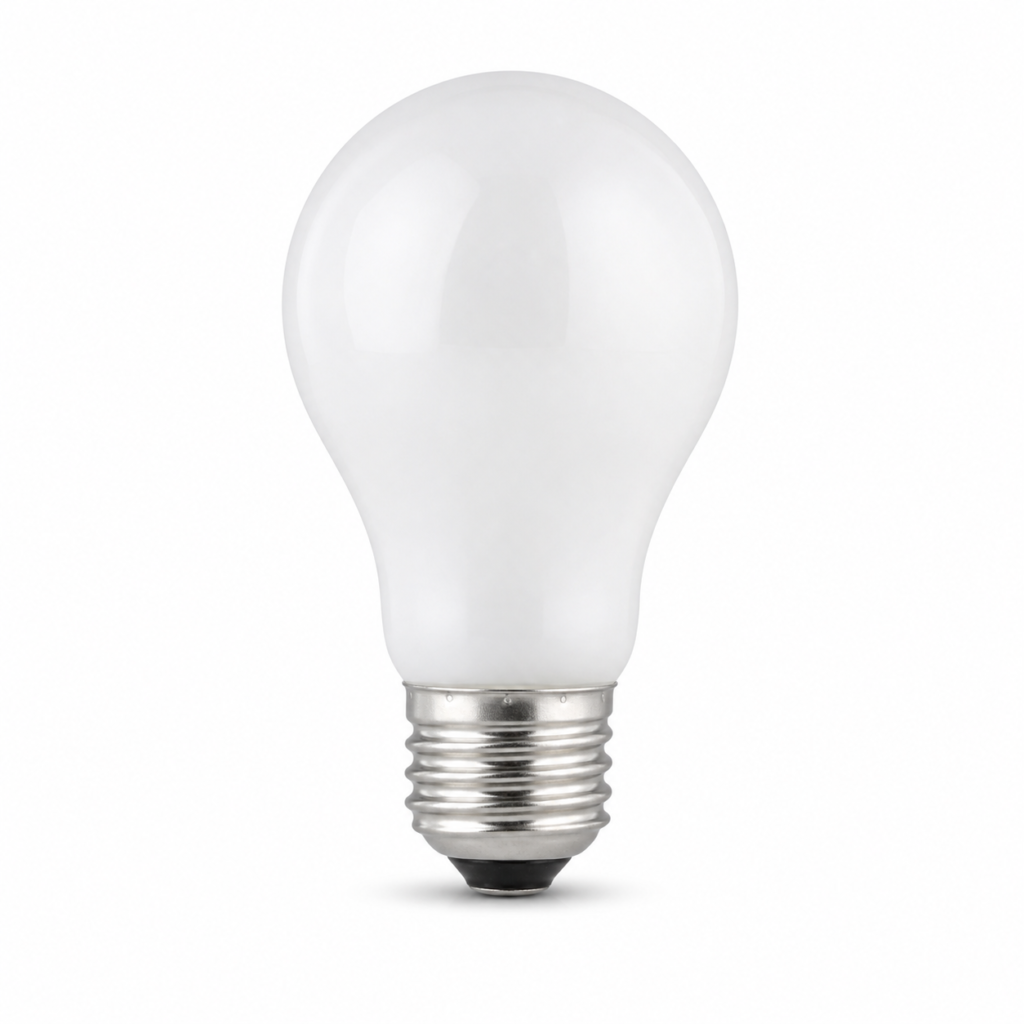
The familiar general-service bulb format used throughout homes and commercial interiors.
A means arbitrary—the classic pear-like lamp shape. The number 19 indicates a nominal diameter of 19 eighths of an inch, approximately 2⅜ inches.
Table lamps, floor lamps, pendants, ceiling fixtures, closets and general ambient lighting.
A19 lamps exist in LED, incandescent and halogen forms with different voltages, outputs, colour temperatures, finishes and dimming characteristics.
Technologies represented in this library: LED, Incandescent, Halogen.
Available base types: E26, E27, B22.
| Technology | Common wattage range | Typical lumen range | Common colour temperatures | Common voltage options |
|---|---|---|---|---|
| LED | 4.5–17 W | 450–1600 lm | 2200K, 2700K, 3000K, 3500K, 4000K, 5000K, 6500K | 120V; 220–240V; universal-voltage options |
| INCANDESCENT | 25–100 W | 250–1600 lm | Approximately 2700K | 120V; 220–240V |
| HALOGEN | 29–72 W | 370–1490 lm | Approximately 2700K–3000K | 120V; 220–240V |
These are representative market ranges, not guaranteed limits. Availability varies by manufacturer, voltage, base, beam, region and product generation.
Choose by base and voltage first, then compare lumens, colour temperature, dimming, enclosure suitability and damp- or wet-location ratings.
Wattage does not measure brightness across different technologies. Compare lumens when replacing incandescent or halogen lamps with LED.
Important: The library describes a lamp format, not a particular product. A shared shape does not guarantee matching voltage, base, dimensions, light distribution or control-gear requirements. Confirm the fixture label and product datasheet, or ask a Bulb World lighting specialist.
Choose by base and voltage first, then compare lumens, colour temperature, dimming, enclosure suitability and damp- or wet-location ratings.
Wattage does not measure brightness across different technologies. Compare lumens when replacing incandescent or halogen lamps with LED.
These are common market ranges. Exact specifications vary by manufacturer and product
Send us a photo, the markings on your existing bulb, or your fixture details. Our team will help you identify a suitable replacement.