
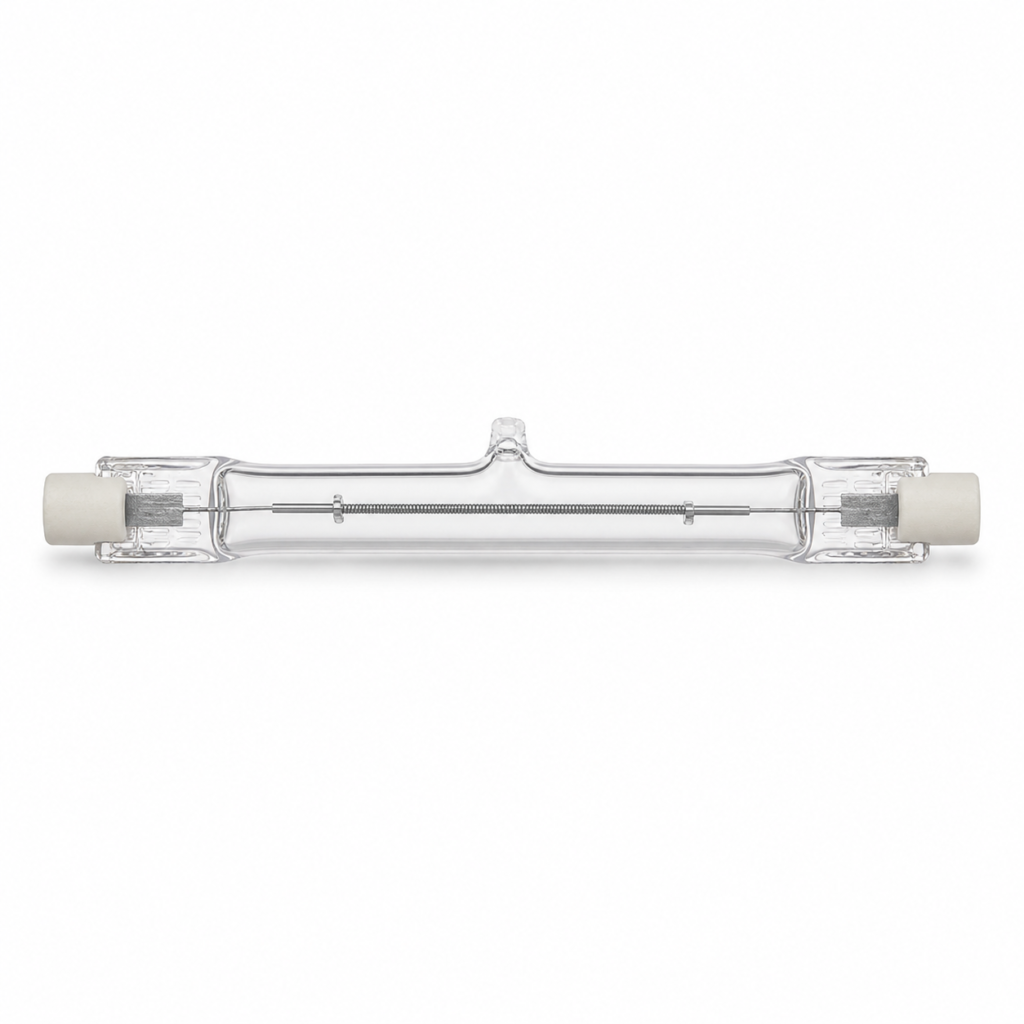
A family of rigid linear lamps with electrical contacts at both ends.
The lamp is a straight tube with a contact at each end. Exact overall length and end-cap style are essential identifiers; common bases include R7s, RX7s and Fc2.
Floodlights, wall washers, uplighters, studio equipment, architectural fixtures and some HID luminaires.
Double-ended linear lamps exist in halogen, LED and HID forms. Base, length, voltage, operating gear and permitted burning position vary by technology.
Technologies represented in this library: LED, Halogen, HID.
Available base types: R7s, RX7s, Fc2.
| Technology | Common wattage range | Typical lumen range | Common colour temperatures | Common voltage options |
|---|---|---|---|---|
| LED | 5–30 W | 400–3000 lm | 2700K, 3000K, 4000K, 5000K | 120V; 220–240V |
| HALOGEN | 60–500 W | 800–10000 lm | Approximately 2900K–3200K | 120V; 220–240V |
| HID | 70–400 W | 5000–40000 lm | 3000K, 4000K, 5000K, 6000K | Ballast-operated; system voltage varies |
These are representative market ranges, not guaranteed limits. Availability varies by manufacturer, voltage, base, beam, region and product generation.
Measure overall length precisely, identify both end contacts, read the fixture label and confirm voltage, control gear, orientation and heat clearance.
A similar-looking linear lamp may require a ballast or ignitor, may have a different operating position, or may be electrically incompatible.
Important: The library describes a lamp format, not a particular product. A shared shape does not guarantee matching voltage, base, dimensions, light distribution or control-gear requirements. Confirm the fixture label and product datasheet, or ask a Bulb World lighting specialist.
Measure overall length precisely, identify both end contacts, read the fixture label and confirm voltage, control gear, orientation and heat clearance.
A similar-looking linear lamp may require a ballast or ignitor, may have a different operating position, or may be electrically incompatible.
These are common market ranges. Exact specifications vary by manufacturer and product
Send us a photo, the markings on your existing bulb, or your fixture details. Our team will help you identify a suitable replacement.